Inside the page
Plugsurfing COO Sofia Diakhate sits on the board of ChargeUp Europe, the association giving the EV charging industry a single voice with EU policy makers. We sat down with her to talk about what's standing in the way of EV adoption, why the industry needs a single voice, and what's at stake if Europe weakens its targets instead of strengthening its delivery.
Coming out on top in the transition to e-mobility requires confidence and stronger execution, not lower ambitions.
That's the view from our COO Sofia Diakhate, who sits on the board of ChargeUp Europe, the association that gives the EV charging industry a single voice in front of EU policy makers.
We sat down with her to talk about what's standing in the way of EV adoption, why the charging industry needs a single voice, and what's at stake if Europe weakens its targets instead of strengthening its delivery.
EV charging needs to become invisible
Two years ago, Sofia made a claim that landed harder than she expected: nobody cares about EV charging. The point was simple. Charging is the necessary step for getting from A to B. Most people don't want to spend time figuring out how it works.
That take has only gotten stronger.
"We're no longer dealing only with innovators or early adopters," Sofia says. "We are now also dealing with the early majority, and the rules of the game are completely different. Innovators and early adopters were experimenters who were excited about figuring out all sorts of brain teasers for getting their car charged. Or at least they didn't mind spending time doing this."
"That's just not the case anymore. The early majority, the group really driving mass adoption, will expect charging to be so seamless that they forget to think about it. It just needs to work."
The three C's: coverage, cost, consistency
If charging just needs to work, the question becomes: what does "work" actually mean? For Sofia, it comes down to three things.
"Coverage means there are enough chargers out there, so that there is one available when you need it.
"Cost is about making sure the price of charging is reasonable, because if the price is prohibitively expensive, the charger might as well not be there.
"And consistency is the quality and reliability side: every component that makes up the end-to-end experience, the hardware, the charging app, customer support, just needs to deliver, time and time again."
These aren't abstract principles. They are must-haves for the mass adoption of EVs.
Confidence is growing, but unevenly
Among current EV drivers, trust and satisfaction are high. They see the cost savings, the reliability, the comfort, the existing infrastructure. They see that e-mobility works and delivers on its promises. Where we still have work to do is with people still driving traditional ICE vehicles. But we are getting there.
"Those not yet in an EV are watching closely and collecting experiences from family, friends, and neighbors," Sofia says. "This is building trust. People are following the public debate, and their behavior is also shaped by the incentives available."
At the same time, Sofia pushes back against blanket reassurances.
"Public charging infrastructure is not the bottleneck for EV adoption, broadly speaking. But we need to admit that the availability of public chargers is unevenly distributed. We have areas that are extremely well served. At the same time, some areas remain underserved. But we also need to remember that public charging is just one way to get your EV charged."
And the picture extends well beyond infrastructure. "This goes beyond the hardware, and even beyond the e-mobility industry. Electrification is no longer only a mobility discussion. It's also an energy discussion, an infrastructure discussion, and increasingly an industrial competitiveness discussion."
From ambition to delivery
"For a long time, the focus was on high-level goals. Goals that look good on paper, but that don't necessarily consider the 'how to' side of things," Sofia says. "As the focus has shifted from headline targets to scalable delivery that also considers business health, the actual bottlenecks are surfacing."
Permitting, grid connections, and grid capacity can be serious obstacles. In some cases, it takes two to three years just to get a permit to install a charger. If not a total showstopper, issues like these can slow things down considerably. "I see several ways AI can help in this space: permitting automation, network planning, visualization."
But regardless of the fix, the principle holds. "The reason doesn't matter so much as the reality that it needs to be fixed."
What's encouraging is how the conversation has changed. "Talking about bottlenecks in a concrete way allows us to find practical solutions. And this conversation has become increasingly collaborative. Within the e-mobility industry, but also beyond: the energy industry, policy makers, OEMs, even technology providers. We are all coming together and having a more pragmatic dialogue."
Pricing: transparency is not enough
"I always like to differentiate between transparency and simplicity," Sofia says. "Transparency means you see the price before you start a charge. Simplicity means the pricing logic is straightforward enough for the average driver to actually understand how much the session is going to cost."
The distinction matters. Seeing a price and understanding a price are two different things if the pricing logic is overly complicated. Sofia sees the root cause in the value chain.
"If every player in the value chain wants to reinvent the wheel and determine its own pricing logic, you add layer after layer of complexity. As a result, the poor driver gets very confused trying to figure out how much charging their car is going to cost this time."
Dynamic pricing is both an opportunity and a challenge. When not done right, it creates another layer of complexity for the driver. But when done right, it steers behavior in ways that can benefit the driver and the broader ecosystem.
"Dynamic pricing needs to be done in a considered way. There can be no compromise on price transparency, nor simplicity. With or without dynamic pricing, the driver needs to know what they're signing up for when they start a charging session."
Why the charging industry needs a single voice
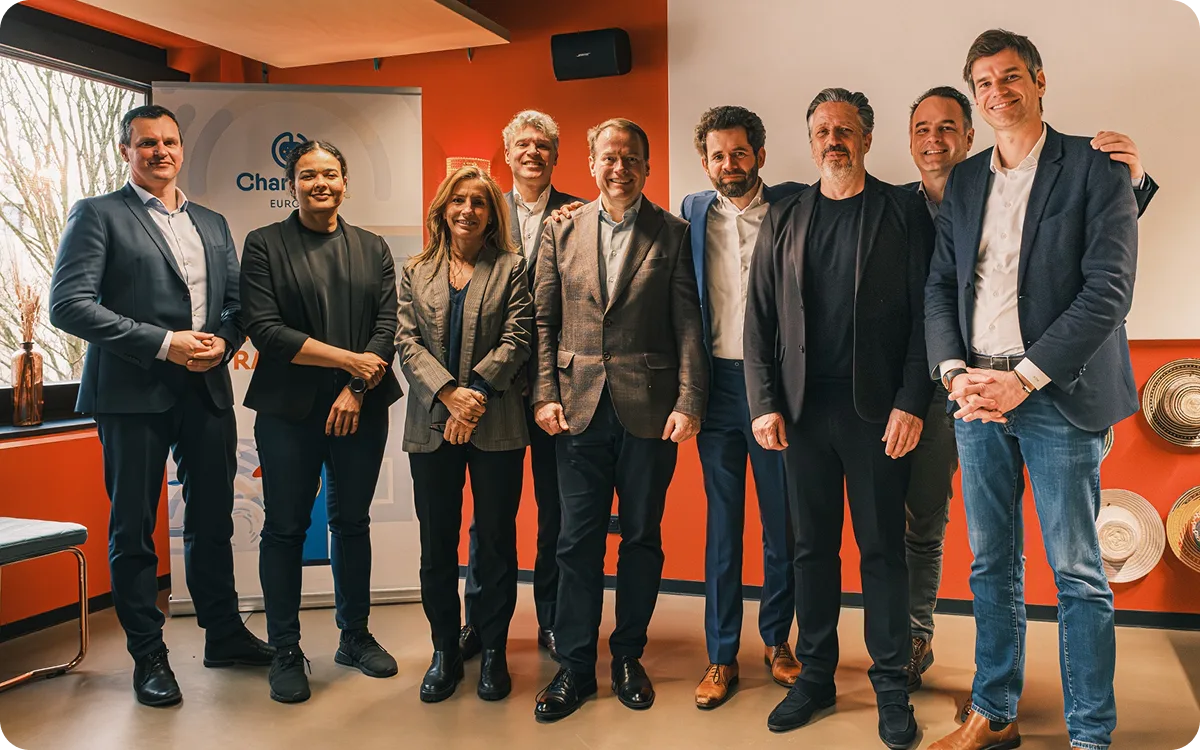
This is where ChargeUp Europe comes in. Plugsurfing has been closely involved with the association for several years, and Sofia's board seat was recently renewed for another two-year mandate.
So what does ChargeUp Europe actually do?
"It brings together the whole European EV charging industry. No one can do this alone. Having our ducks in a row and going to policy makers with a single ask is much more powerful than everyone trying to figure things out individually."
Sofia describes two core functions.
First, defending the policy architecture. "ChargeUp Europe works closely with policy makers around AFIR, CO2 emissions standards, and the electrification of corporate fleets. That policy backbone is what we're building the future on. Long-term predictability is absolutely essential."
Second, identifying and working through practical issues. "ChargeUp Europe facilitates discussions across its membership to surface practical issues and work through them together. Permitting, grid connections, interoperability, VAT, cable theft, cybersecurity, those are all part of that."
And ChargeUp Europe is evolving as the industry evolves. "Policy and regulation is not the answer to everything. There are things you can hash out between organizations and industry sectors without waiting for regulation."
Many of the challenges around pricing complexity, data quality, and interoperability don't necessarily require new regulation. They require industry coordination, pragmatic dialogue, and alignment around solutions that serve both the ecosystem and the driver. ChargeUp Europe is a great think tank for this.
"At the end of the day, we want to support market-driven solutions as much as possible. We don't want to resort to further regulation unless absolutely necessary. What better starting point than to come together and have an open and constructive dialogue, one that keeps our joint goal at the center?"
Plugsurfing at the table
Why does Plugsurfing's voice matter in this context?
"The policy conversation around EV charging tends to focus on the physical infrastructure: chargers and grids," Sofia says. "But that's not the whole picture. We need to think about the end-to-end driver experience and everything that impacts it: interoperability, roaming, pricing. That's why it's important that we have a seat at the table."
"What we bring to the table has also evolved. Plugsurfing has operated across multiple layers of the ecosystem over its journey, from CPO activities to CPMS and eMSP services. Today, we are very focused on the eMSP layer and on the end-to-end driver experience. That clarity has also sharpened how we contribute in policy discussions. We've been able to take our place within ChargeUp Europe and be recognized for what we bring."
Corpay's scale registers too, Sofia adds. "Corpay is a sizable corporate payments company, specializing in fleets, with a global presence. We are also tapping into this experience and expertise."
Don't weaken the targets. Fix the delivery.
"Europe does not need weaker targets. It just needs stronger delivery."
Stronger delivery means focusing Europe's energy on solving the known bottlenecks: permitting, grid access, investment certainty, interoperability, and scalable business models. The question should not be how to lower ambition. It should be how to deliver against it more effectively.
The good scenario: Europe shows leadership, keeps the long-term targets in place, fixes the bottlenecks, and builds the industrial base for the next two decades of e-mobility.
The bad scenario: short-term pressure wins, targets get watered down, investment moves elsewhere, and Europe ends up importing what it could have built itself.
"Who will lose? Europe as a whole," Sofia says. "I hope that's incentive enough not to go down that path."
"We shouldn't respond to short-term pressure by weakening long-term certainty. That long-term certainty is what our entire industry is being built on."