Inside the page
If you charge at home, you pay for electricity. That’s about it. Public charging is different. Every kilowatt-hour you pull from a public charger carries costs that simply don’t exist at home. Understanding where your money goes makes the price easier to accept, even when it stings.
Home charging is cheap for a reason
When you plug in at home, you’re using your existing electricity connection. No one built a dedicated station for you. No one maintains equipment in a parking lot. No one processes your payment through multiple systems.
Your home electricity rate covers the energy and a share of the grid. That’s the whole bill.
Public charging carries a longer list of costs
A public charge point operator (CPO) pays for a lot more than electricity. Here’s what sits behind every kWh you buy at a public charger.
The electricity itself
This is the most obvious cost, but it’s not straightforward. CPOs don’t pay a simple household rate. They buy electricity on commercial terms, often tied to wholesale market prices that shift throughout the day. When demand is high, the price spikes. When the sun shines and the wind blows, it drops.
Most operators absorb these swings rather than passing them directly to you. That means the price you see in the app is an average: high enough to cover expensive hours, stable enough to be predictable.
Grid connection and network fees
This is the part most people don’t see, and it’s often the biggest single cost.
Connecting a fast charger to the electricity grid isn’t like plugging in a kettle. A single DC fast charger can draw as much power as dozens of homes at once. Grid operators charge for that capacity, often based on the highest peak load recorded in a billing period.
One busy afternoon with several cars charging at the same time can set the grid fee for the entire month. These fees alone can account for 40 to 60 percent of a CPO’s operating costs.
Hardware and installation
A single DC fast charging bay can cost hundreds of thousands of euros to install. That includes the charger itself, electrical infrastructure, cables, safety equipment, and construction work. Grid upgrades, like new transformers or higher-capacity connections, can add even more.
This investment needs to be paid back over the lifetime of the equipment, typically ten years or more. Every charging session carries a share of that upfront cost.
Land and location
Chargers need space, and space costs money. CPOs lease parking spots, negotiate with property owners, and pay for the right to operate on someone else’s land. Prime locations near highways, shopping centers, or city hubs come at a premium.
Maintenance and uptime
Chargers operate outdoors, around the clock, in every weather. They need regular maintenance, software updates, and occasional repairs. Keeping a charger available when you need it is an ongoing cost, not a one-time expense.
Payment processing
Every transaction runs through payment systems. Credit card fees, mobile payment processing, and back-end billing systems all take a small cut.
Software and operations
Behind the charger you see, there’s a management platform handling sessions, monitoring hardware, publishing real-time availability, and keeping everything running. None of that is free.
What about charging apps and roaming?
There’s one more layer worth knowing about. How you pay affects the price.
If you use a CPO’s own app, you typically get their direct price. If you pay with a contactless credit card at the charger, same thing. But if you charge through a third-party app like Plugsurfing, there’s an additional cost built in.
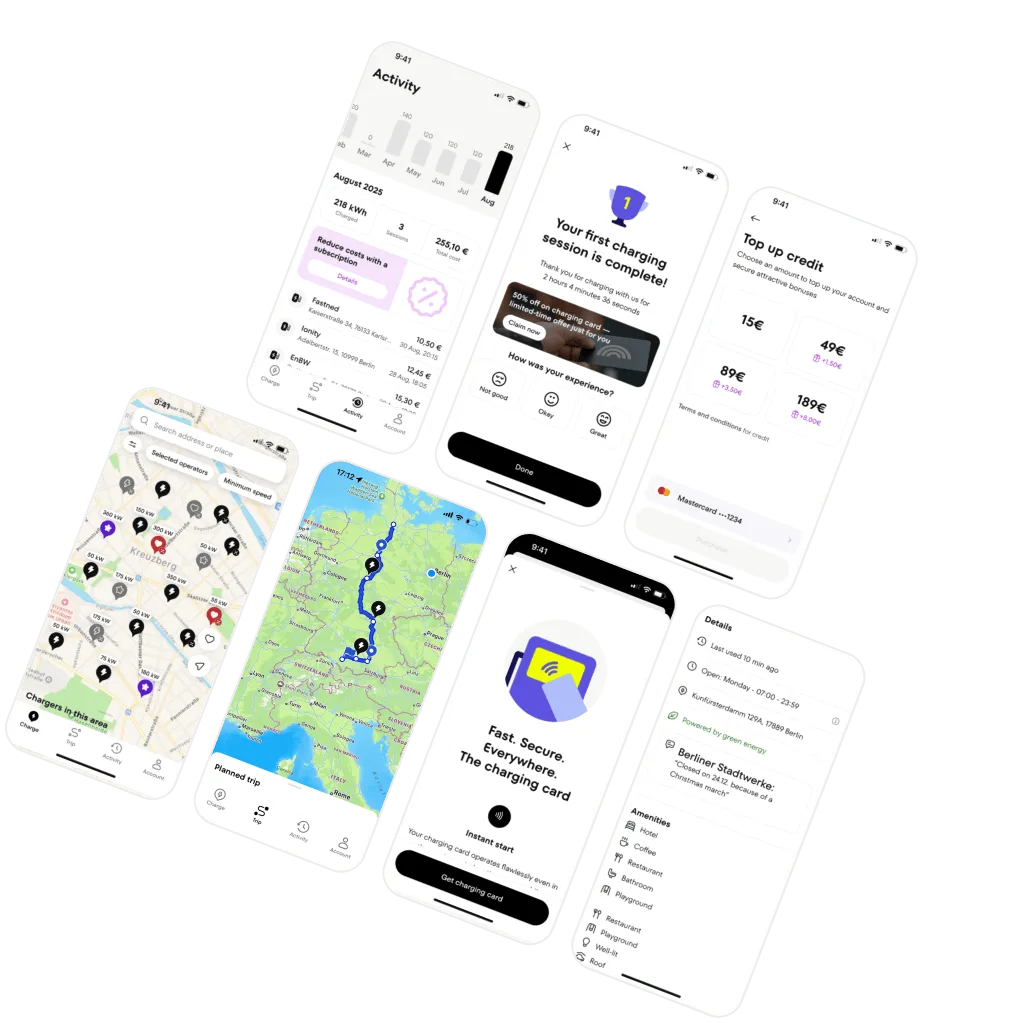
That’s because roaming works like it does with mobile phones. Plugsurfing connects you to charge points from over 900 operators across Europe. Maintaining those connections, handling billing between operators, and keeping the network running costs money. That cost gets added to the per-kWh price you see in the app.
So yes, charging through Plugsurfing can cost a few cents more per kWh than going direct. What you get in return:
- No more app-hopping: One app, one account, and one payment method. No downloading ten different apps. No guessing which operator runs which charger.
- Remote or touch: Start and stop charging sessions in your app or using a charging card.
- Charging costs in one place: Whether it’s just you, your family, or an entire business using your Plugsurfing account, you don’t need to hunt for receipts.
- There’s always another charger: our charging solution works in 26 countries and 1M+ charge points. If one charger doesn’t work, find another and top up.
Whether that convenience is worth the extra cost depends on how you charge. If you always use the same two or three chargers close to home, direct apps might be all you need. If you travel, charge in different cities, or simply want everything in one place, that’s where Plugsurfing earns its keep.
Why is the price more than just kWh?
One of the most common frustrations with public charging is seeing charges on your receipt that aren’t simply energy. Here’s what those extra components mean and why they exist.
Idle fees (blocking fees)
These kick in after your car has finished charging but is still connected. The charger is full, your battery is full, but you haven’t unplugged. The fee encourages you to free up the charger for the next driver. This is the simplest time-based charge, and the easiest to avoid: once your battery is full, unplug and free up the spot for the next driver.
PRO TIP: Turn on the push notifications in your Plugsurfing-powered charging app to receive push notifications before any blocking fees kick in.
Time-based charging
Some operators charge per minute from the moment your session starts, or after a set number of minutes, even while your car is still actively charging. This isn’t a penalty. It reflects a real cost problem: the fuller your battery gets, the slower it charges. A car that’s 80 percent full might sit at a fast charger for another 30 minutes to reach 90 percent, using a fraction of the charger’s capacity while blocking it for others.
The time-based fee nudges you toward the most efficient use of fast chargers: arrive low, charge to 80 percent, and move on. It also reflects the fact that the CPO’s costs (grid fees, land, hardware) are tied to time as much as energy.
Congestion pricing
Some networks vary their prices based on how busy a station is. If every charger is occupied and drivers are waiting, the price goes up. If the station is mostly empty, it comes down. The logic is the same as peak and off-peak pricing in public transport: spread the load, reduce queues, and make better use of the infrastructure that’s already built.
Dynamic pricing
A newer model ties the charging price more directly to the actual cost of electricity at that moment. When renewable energy is plentiful and wholesale prices drop, charging gets cheaper. When the grid is under pressure and electricity is expensive, the price rises.
This is still uncommon, but it’s worth understanding. Dynamic pricing rewards flexibility. If you can charge during off-peak hours, you’ll pay less. Over time, it could also help balance the electricity grid by steering demand toward hours when clean energy is abundant and cheap.
CPOs aren’t pocketing the difference
It might feel like someone is making a lot of money on the gap between your home electricity rate and what you pay at a public charger. The reality is different.
Most large charging operators are still working toward profitability. High upfront investment, grid fees that can spike unpredictably, and utilization rates that are still growing all put pressure on margins. Industry-wide, profit margins for charge point operators typically sit between five and 15 percent, and many operators are still running at a loss as they build out their networks.
The price you pay covers a real cost stack. It’s not a markup on electricity. It’s the cost of building, powering, and maintaining the infrastructure that makes public charging possible.
Will it get cheaper?
Public charging costs have been coming down and will likely keep improving. More chargers mean more competition. Higher utilization means fixed costs spread across more sessions. Smarter grid management and dynamic pricing help operators control their electricity costs. And as the market matures, the entire cost structure becomes more efficient.
Home charging will probably always be cheaper, just like cooking at home is cheaper than eating out. But the gap should keep narrowing as the charging network grows.