Inside the page
The EV charging market is maturing. Networks are growing. More drivers are on the road. But for the businesses building charging solutions, the real question is shifting: what does it take to deliver a seamless charging experience that actually works at scale, across borders, and over time? We sat down with our Head of Product, Xenia Antipova, to talk about what’s changing in the market, what that means for our product, and where Plugsurfing is headed in 2026 and beyond.

The charging experience is moving into the car
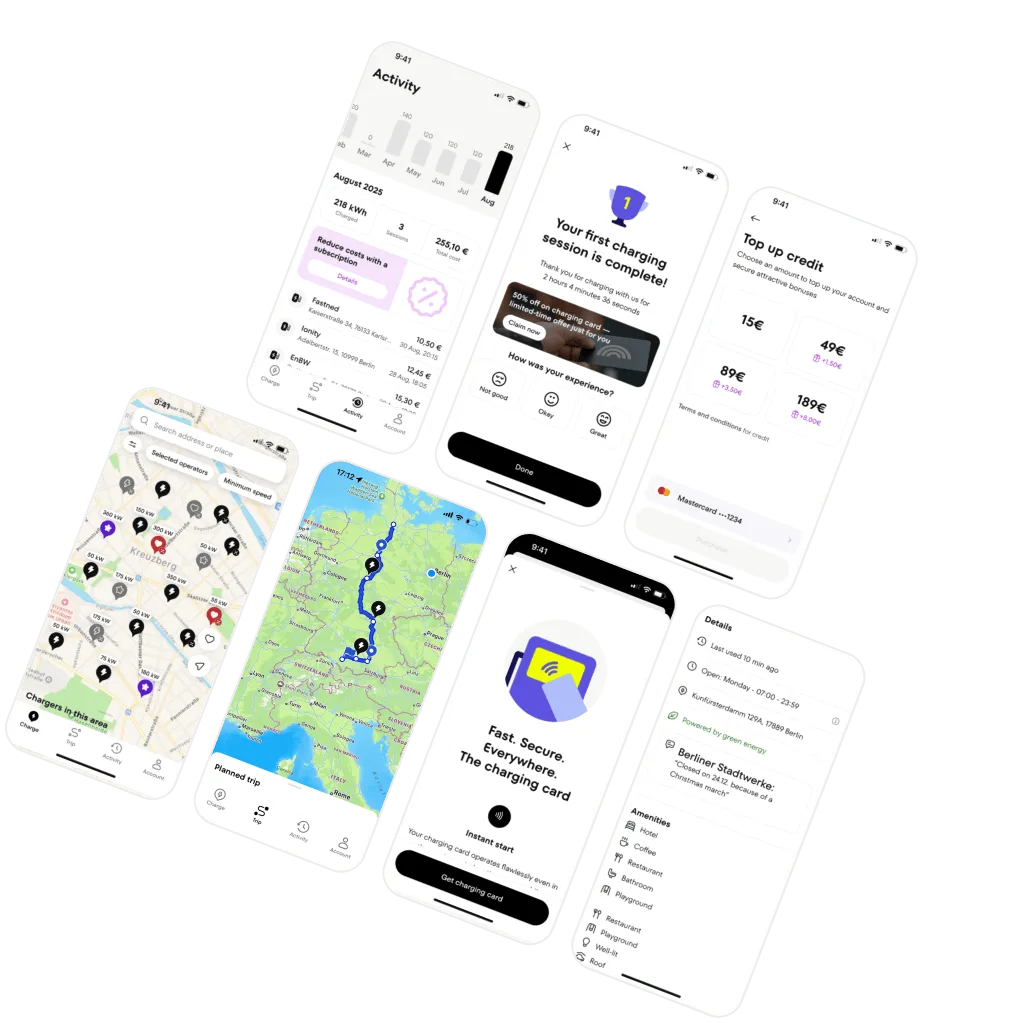
One of the biggest shifts happening right now is where the charging experience lives. Apps, charging cards, QR codes: drivers have used different tools to find chargers, start sessions, and manage their charging. That mix is changing.
Plug&Charge is gaining ground. More vehicles support it. More drivers expect it. And as authentication moves into the car itself, the role of everything else changes with it.
“The app isn’t going away, but what drivers use it for is shifting,” says Xenia. “Setup, account management, subscriptions, reporting. The actual charging interaction is becoming something the car handles. For us, that means building the intelligence layer that makes it all work, whether the driver touches the app or not.”
For OEMs and mobility platforms, this has practical implications. The visible interface may sit in the vehicle or the partner’s own app. But the service logic, the network access, and the data needs to come from somewhere reliable. That’s the layer Plugsurfing operates in.
Access alone is not enough
A million charge points across Europe is a strong starting point. But access alone is not a differentiator for long. What matters next is what you can do with the data that comes from all those sessions.
Which locations perform well? Where are drivers struggling with availability? How does pricing affect behavior across different markets? These are questions that Plugsurfing can help answer, not just for its own product decisions, but for the partners and customers connected to our network.
“We process a lot of charging data across a lot of markets. That gives us a view that most individual operators or OEMs don’t have on their own. The question we’re asking ourselves is: how do we turn that into something our customers can actually use to make better decisions?”
For CPOs, that could mean better insight into how roaming traffic behaves on their network. For OEMs and fleet operators, it could mean clearer visibility into charging patterns, costs, and network quality across regions, so they can shape their offering around what actually works for their drivers.
This is still early, but the direction is clear: the value of a roaming partner is not just the connections it provides, but the intelligence it builds on top of them.
Building products, not projects
As the customer base grows and diversifies, one of the biggest internal challenges is the pull toward customization. Every partner has specific needs. Every market has quirks. The temptation is to build something tailored for each situation.
But that approach does not scale. And it creates risk: more custom work means more things that can break, more maintenance, and slower delivery for everyone.
“We’re being deliberate about turning recurring needs into standard products,” Xenia explains. “If three customers need a similar capability, that’s a signal to build it once and make it available to all of them, not to build it three times.”
This matters for partners too. A standardized, modular product means faster onboarding, more predictable behavior, and fewer surprises in production. It also means that when Plugsurfing improves something, every customer benefits, not just the one who requested it.
The same principle applies to operations. Expanding the product only works if the operational foundation can support it. That means investing in processes, automation, and system reliability alongside new features, so that growth does not come at the cost of stability.
What’s on the 2026 roadmap
The product priorities for this year are tied directly to the trends above.
Fleet capabilities are expanding. Plugsurfing has recently launched a white-label fleet app, with functionality specific for fleet drivers. We are also developing a white-label fleet portal and working with early partners to validate the experience. Ayvens, a global leader in vehicle leasing, chose Plugsurfing to power their charging solution after evaluating over 20 providers. Fleet-level network filtering gives fleet managers control over which CPOs their drivers can access, helping them manage costs and standardize the charging experience across their operations.
Roam OCPI is scaling up. As more CPOs and EMSPs connect through Roam OCPI, the focus is on making activation faster and the connection more reliable as the network grows. The goal is simple: one integration that gives customers access to Europe’s charging infrastructure without the complexity of managing it themselves.
Plug&Charge readiness. As in-vehicle authentication becomes more common, Plugsurfing is making sure its infrastructure supports it. The Plugsurfing app and partner solutions like Polestar Charge already support Plug&Charge, and the product team is preparing for broader adoption across the network.
Fraud protection continues to grow. More sessions, more markets, and more payment methods mean more surface area for fraud. Plugsurfing is investing in detection and prevention to keep transactions secure across the network.
Looking further ahead
The role of an e-mobility provider is expanding. Today, it’s primarily about charging access and roaming. Over the next few years, the market will likely push EMPs toward broader capabilities: smarter energy management, deeper fleet integration, and more intelligence built into the charging experience itself.
Plugsurfing’s approach is to build toward that future from a strong foundation: reliable roaming, good data, and operational depth. Not everything needs to happen at once, but the groundwork matters.
“Our job is to make charging work, and to keep expanding what that means. Today it’s access and reliability. Increasingly, it’s about helping our customers use the data and infrastructure we’ve built together to create real business value. That’s where we’re headed.”
Want to learn more about how Plugsurfing’s products can support your business?